


Jatinangor, 30 June 2026 – The Library Laboratory of the Faculty of Communication Sciences, Universitas Padjadjaran, in collaboration with Difoss Holding, organized the second day or Session 2 of the Data Intelligence for Information Services Workshop titled “Data Behind Services.” The event, held online via the Zoom Meeting platform, aimed to improve the quality of data management and evidence-based information services.
The series of activities in this session was guided interactively by Nazwa Azzahwa as the MC/Moderator. The second day of the workshop featured Febriyanti Bifakhlina, S.IIP., M.P., a lecturer from the Library and Information Science Study Program at Unpad, as the main speaker who guided repository and library managers in mastering advanced data analytics.
In her explanation, the speaker elaborated that Omeka is a MySQL-based platform focused on managing and exhibiting digital collections such as archives, photographs, and cultural objects. She thoroughly examined the Dublin Core metadata standards implemented in the system, but she provided critical notes regarding semantic limitations, as the vocabulary used was still dominated by Dublin Core Terms (dcterms), while aspects of access rights or licensing (rights) had not been optimally filled. Through this data dissection, participants were reminded of the importance of detecting and avoiding metadata duplication, as it risks affecting the accuracy of data calculations on dashboards, increasing the potential for curation errors, and reducing the overall quality of digital collection management.
After the theoretical material was delivered and served as a foundation for understanding, participants were immediately directed to conduct independent practicum sessions. In this practice stage, participants directly inputted metadata instruments on the Omeka S platform to understand digital curation mapping. The session then continued with practicing the use of SLiMS as a reliable library automation system to manage collection data and library service circulation in real terms. The combination of introducing these two platforms trained participants to distinguish between the operational data orientation in SLiMS and the semantic curatorial characteristics of data in Omeka.
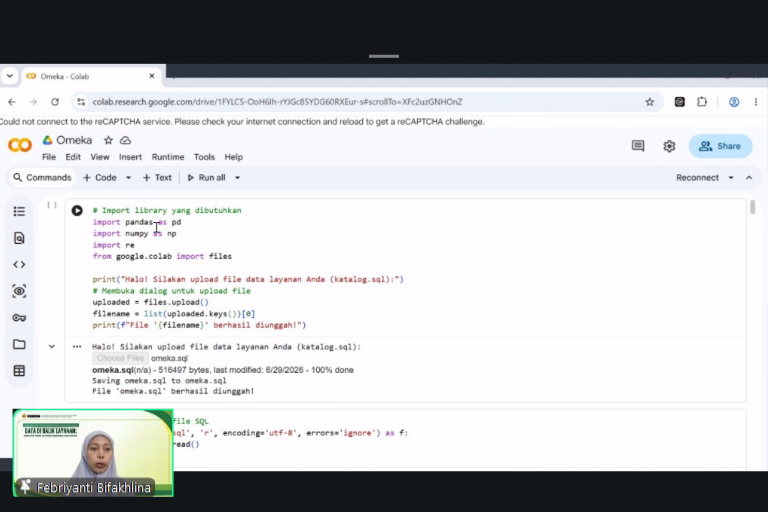
In the final session of the workshop, participants were introduced to the initial stages of analytical data processing using the interactive Google Colab environment. This stage began with training participants to upload service data files, check the existence and size of files using the pathlib module, and utilize the Pandas library to read data into DataFrame structures. However, during the practicum, a real technical obstacle was encountered because the database file used was in the omeka.sql format (an SQL database), while the code instructions could only read files with CSV extensions. This technical issue became a valuable learning lesson for participants regarding the importance of understanding data formats, requiring additional steps such as importing the SQL database into a database management system first or converting it to CSV format before the data could be analyzed using Python.
Overall, Session 2 of this collaborative workshop successfully equipped repository managers with the technical capacity to transform raw data into measurable decisions.


