


Jatinangor, June 29, 2026 – The Library Laboratory of the Faculty of Communication Sciences, Universitas Padjadjaran, in collaboration with the Fikom Academic Business Unit and Difoss Holding, organized a Data Intelligence for Information Services Workshop titled “Data Behind Services.” The activity, held online via Zoom Meeting on Monday, June 29, 2026, aimed to improve the quality of data management and evidence-based information services. The workshop was attended by librarians, archive managers, and institutional repository managers who were enthusiastic about deepening their skills in reading patterns and solving service problems through the utilization of accurate data.
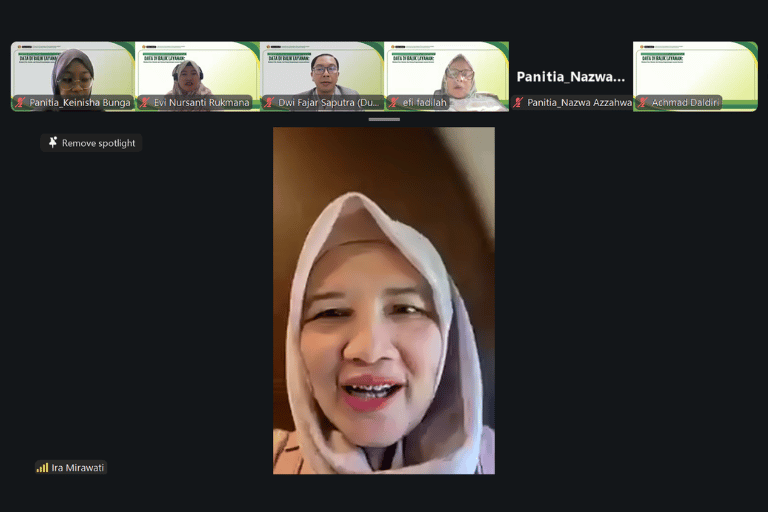
The opening ceremony was guided by Nazwa Azzahwa as the MC/Moderator and featured a report from the Head of the Fikom Library Laboratory, Evi Nursanti Rukmana, M.I.Kom., as well as remarks from the Head of the Fikom Academic Business Unit, Dr. Efi Fadilah, S.Sos., M.Pd. The Chairman of Difoss Holding and the main speaker, Dwi Fajar Saputra, S.Sos., M.M., also delivered a speech before being followed by the Vice Dean for Academic, Student, and Research Affairs, Dr. Ira Mirawati, M.Si. In her address, Dr. Ira Mirawati emphasized that this initiative is a strategic step for Universitas Padjadjaran to enhance data-based library services so that the institution becomes increasingly advanced in its service delivery.
In this first session, Dwi Fajar Saputra, S.Sos., M.M., delivered in-depth material on the role of data in information services, referring to the material “Slide Workshop Day 1 Session 1 Data Introduction FINAL.pptx.” Participants were invited to understand the workflow from raw data to targeted policy-making. The speaker emphasized that well-organized data will help information institutions read patterns, problems, and opportunities. This session highlighted four crucial aspects before conducting visualization: clear analytical objectives, determining target users, the availability of valid data, and establishing appropriate indicators. Entering the technical session, participants were introduced to “Python Introduction.pptx” as a tool for processing information service data.
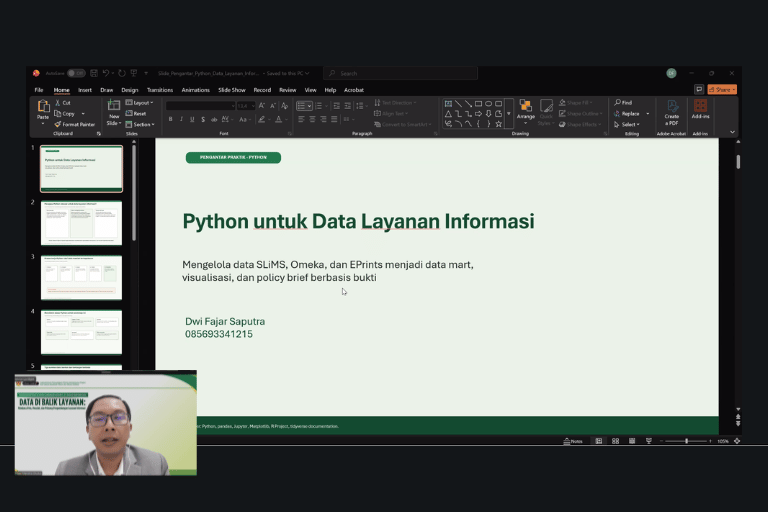
Participants learned to use Python, Google Colab, and the Pandas library to examine table structures, identify null values, and handle data duplication that often occurs in circulation and catalog datasets. The main focus on the first day was the participants’ ability to perform data cleaning so that the analysis results would not be biased. Additionally, participants also began practicing initial pattern reading, such as calculating the most frequently used service categories and collection usage trends. As a conclusion to the first day’s series of activities, all participants successfully achieved several output targets, including service datasets that had been opened using Python, neater datasets, simple summary tables, and notes on initial patterns from their respective service data.


