


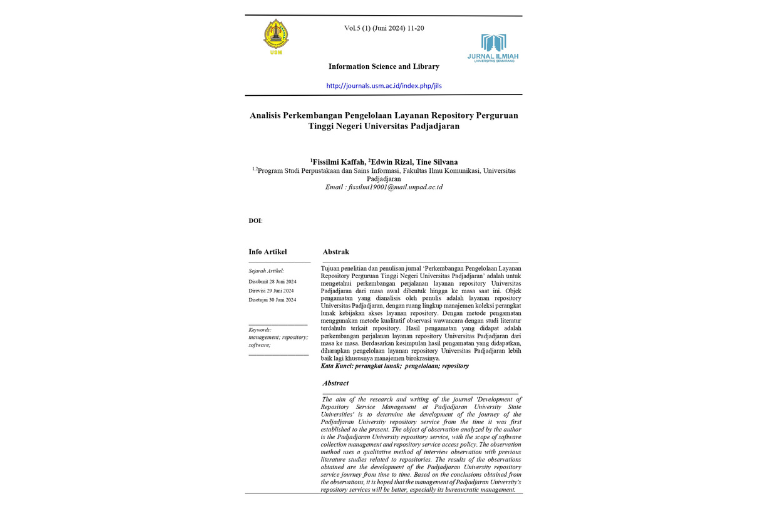
Students of the Library and Information Science Study Program conducted an Analysis of the Development of Repository Service Management at Padjadjaran University. This study traces the development of the repository since it was first initiated in 2009 to its current condition in 2024.
Conducted by Fissilmi Kaffah, Edwin Rizal, and Tine Silvana, the study employed qualitative methods, including observation, interviews, and literature review. It focused on the evolution of collection management, software platforms, and access policies within Unpad’s repository system.
The findings highlight several significant phases: starting from the Scientific Work Submission (SSK) system in 2009, migrating to Dspace (2011), then EPrints (2016), OPUS (2019), and most recently returning to Dspace after system maintenance in 2024. Each phase demonstrates efforts to improve access but also reveals challenges such as technical failures and limited full-text availability for users.
Unpad’s repository serves as a strategic digital archive of student and faculty research. By integrating with Indonesia’s national repository system (RAMA), it not only helps prevent plagiarism but also enhances the visibility and accessibility of academic works. This positions the repository as a key driver in strengthening higher education and research governance.
The repository’s role directly contributes to the Sustainable Development Goals (SDGs), particularly SDG 4: Quality Education, by promoting open access to knowledge, strengthening academic literacy, and supporting learning resources. It also supports SDG 9: Industry, Innovation, and Infrastructure, by providing innovative digital infrastructure, enabling research collaboration, and boosting institutional reputation globally.
“Repositories are the face of universities in providing knowledge to society. With stronger management and governance, Unpad can improve information services while supporting sustainable development goals,” stated the researchers.
This study emphasizes the importance of continuously improving repository management to ensure it remains an inclusive, useful, and innovative hub of knowledge that contributes to both education and innovation in Indonesia.
Full article available at: http://media.unpad.ac.id/files/publikasi/2025/rpm_20250123143320_4083.pdf
Writers: Ridha Amalia, Nadziva Shaqeena Firdaus, Shelpi Nur Awaliyah


